
Just the Ticket!
Just the Ticket!
Parking Policy for Lower Carbon Travel
State of the Nations
In 2022 the Transport Planning Society updated its key strategic statement “State of the Nations: Transport planning for a sustainable future”.
There is an urgent need for us to reduce carbon emissions. As transport is now the largest source of UK emissions of greenhouse gases, it presents one of the keys to a more sustainable world. But there is also an imperative to improve people’s health and wellbeing.
The key statement in the State of the Nations is that travel in Britain is dominated by motor vehicles, reflecting a policy and planning approach that for decades has assumed that people have (or should have) access to private car to meet their daily needs. But if we are to deliver a more sustainable future current travel patterns need to change dramatically.
There are other options, that are cleaner, greener and healthier. We need to not only consider these options, but begin to put them in place, so that as a society we start to naturally select different and more sustainable travel choices.
The Significance of Parking
Any travel by motor vehicle invariably relies on parking. Be it at the destination or origin of a trip, the parking space is a key enabler and important component in the overall choice of how we travel. Locate the parking space further from the destination, and travel by car becomes less convenient; make the parking more expensive, and choosing car is less attractive; remove the parking space altogether, and taking the car, or owning a car, becomes untenable.
Parking policy is thus an important aspect in delivering the transport system we want for the future. This paper sets out three headline themes relating to parking that the Transport Planning Society consider to be fundamental as part of driving the change we need:
- What we need from our planning laws
- Making the use of space more equitable
- Environmental taxes and charges
It concludes with why this is so important, and why parking is such a ready-made vehicle to deliver the much of the change we need when it comes to how we travel, alongside measure designed to reduce the need to travel for daily life requirements and improve the opportunities to travel on foot, by bicycle and public transport.
What we need from our planning laws
It’s no secret that one of the most hotly contested issues in a neighbourhood is about who parks where. The ordeal of finding a parking space near home occupies families on a daily basis. Significant local disturbances and grievances arise when vehicles are parked in conflict with others’ needs and desires. More broadly, attempts to introduce changes to parking provision (including parking restrictions) can be politically challenging, like changes to local traffic priorities such as traffic-calming measures.
Planning Guidance on Parking for New Developments
At the beginning of the century, Central Government set limits on the amount of parking that could be provided for new developments[1]. The thinking was that if there was less parking available at the destination, other more sustainable modes would be more attractive. The bus might take someone right to the door of their destination, whereas the nearest available parking may cost more and be a little walk away. A reduction in the amount of parking allowed for residential developments would limit how many cars people could own. Car ownership is known to be a major factor in mode choice.
By the time the recession was taking hold, it was apparent that the policy was having some impact.
In some urban areas, the reduced provision of household parking was causing some residents to re-consider whether they needed to own a car. There was a distinct change in how predominantly young people were living, seeing the car as unnecessary and enjoying high density urban lifestyles[2].
For many cities, towns, suburbs and rural hinterlands however, restrictions and higher costs of parking at town centre destinations were not necessarily driving modal shift, but rather drawing patrons to use edge and out of town destinations that had, and were being built with, ample and often free, parking.
Furthermore, car ownership in many of the residential settlements built during this period wasn’t diminishing. Despite the streets being designed with fewer parking bays and less in-curtilage capacity, residents were still owning cars. These were being parked on corners, on the pavements and on the green spaces at the heart of, and to the significant detriment to, the communal space of the neighbourhood. Without prompt and active control of invasive parking, it has quickly become the norm and accepted practice.
The strategy to change behaviour by limiting parking had a number of leaks.
In 2008, after nearly a decade of parking maximums, Essex and Kent County Councils advocated an approach that maintained maximums for non-residential use but applied minimums for residential developments. The philosophy was that car ownership was not in itself a problem, and largely could not be constrained by limiting parking without onerous enforcement. Limiting parking at the destination however, could and should continue to influence mode. Housing developments with limited parking were creating significant community pressures and/or overspill causing loss of amenity to existing residents.
By 2012, central government thinking adopted similar lines. What was key was that car use should be appropriate. Explicit controls on the amount of parking that was, or was not to be provided, were removed[3].
Most local authorities adopted this approach. Developers proposed within their planning application the parking provision necessary on their site in order to make the development viable and the properties attractive to their market. At the point of application, many local authorities insisted on the parking provided to be increased to avoid overspill into neighbouring streets.
Some urban cores continued to see developments come forward with little or no parking. For a number of developments in locations where housing was in great demand and suitable for urban lifestyles, space consumed by parking was wasteful and expensive and otherwise diminished the amount of accommodation that could be developed on the site.
Most local authorities with constrained urban centres, continued to maintain limits on the parking that could be provided for destinations in accessible locations served by public transport. In effect, offices, shops, leisure and entertainment venues in town and city centres were approved with little or no on-site parking. In contrast, housing was in many cases required to provide a minimum level of parking for residents.
In many other non-urban locations, the market drivers have resulted in new developments, both residential and commercial, being created at low densities. Light industry and business parks have come forward in edge of urban locations with substantial parking; standard build housing estates have large driveways, gardens and other characteristics of sprawl.
Those working at these locations have limited option but to drive. Those living in these areas face substantial walks to goods and services and invariably find owning and using a car the most practicable option. Regardless of any propensity to do so, the significant distances created between and within the development means that walking or cycling is not attractive. The low density means that there are not enough passengers within reach of each bus route to sustain a frequent or direct bus service. This low frequency of service diminishes the attractiveness of the bus as a travel option, and reinforces the apparent necessity of these residents to own a car[4].
In more recent years, the market-driven needs to deliver more housing on the space available has to some extent become embodied in a revision to government guidance[5]. The provision of good public transport coupled with planning restraints on parking has played a key role in supporting the delivery of new high-density developments in a number of urban locations.
This approach is not limited to urban in-fill. Significant new residential developments, as part of the garden village initiative, are being planned with explicit limits on the amount of parking provided.[6]
There is a move back to recognising that designing new development with access to local goods and services and transport is crucial to creating the places people wish to live and work in. One of the lasting impacts of the pandemic appears to be an increase in walking to and from, and use of more local goods and services[7].
Where lower parking provision and higher housing densities an intrinsic part of the design, distances are reduced, walking and cycling routes are prioritised, and travel to and from attractors is direct and convenient. If new housing is to be imaginative and avoid the indifferent, enforcing a reduction in parking provision through the planning process is a fundamental and long-term solution for bringing about a permanent change in travel habits and curating a sense of place[8]. But this needs to be supported by policies that improve local access to goods, services, and opportunities and ensure provision of high-quality walking, cycling and public transport alternatives to car travel.
|
Recommendation 1. The Government should establish new guidelines on the maximum amount of car parking to be provided at new developments |
While the efficacy of this policy may be clear, there is an evident difficulty of establishing a sudden and abrupt shift away from many people’s lifestyles that are reliant on access to goods and services by car. For decades decisions on the siting of the facilities that provide goods and services have been based on an assumption that most would use a private car to reach them. We only have to look at how healthcare, shopping and many significant employers have moved from town centre or urban locations to edge of town and greenfield sites. These have proved difficult to serve by bus and too far to be readily served by cycle or on foot.
Therefore, simply reducing the parking that is available isn’t practicable as a hard-stop policy. It must be delivered in a way that allows the population time to make adjustments and presents realistic alternatives and incentives to change lifetime habits.
Changing travel behaviour and delivering fundamental changes to our carbon generation through parking policy is a good strategy. But the approach must be nuanced both in application and timing.
Residential Developments
The experience of the early 2000s demonstrated that restricting parking provision for new housing didn’t necessarily stop residents from owning cars. They parked their cars on the verge, the footway or in neighbouring streets. All these actions have had a detrimental impact on the local environment and amenity for others. In particular, the use of neighbouring streets often impacted existing residents, who found it increasingly difficult to find space for their own cars, and were vociferous in challenging the planning authority’s wisdom in allowing developments without their own in-curtilage parking to proceed.
Experience and policies have since developed meaning that this issue can be addressed. In those locations where on-street parking is already at a premium, local highway authorities have already introduced controlled parking zones or other similar controls. Only those with a permit are entitled to park on the highway in the bays designated for that purpose. An increasing number of highway authorities, including several London boroughs, have been making it a condition of planning consent for new developments, or properties that are refurbished such that they may increase the number of cars owned, that those properties are not included in the list of those eligible for residential parking permits. Those moving into these properties do so with the knowledge that they, and any successors in title, will not be able to apply for a parking permit in the local streets[9]. This solution ensures that there is no additional parking demand pressure on those who already have a permit, while allowing a new generation of residents to establish car-free lifestyles within those neighbourhoods.
|
Recommendation 2. Highway Authorities should use on-street parking controls to ensure that new developments approved on the basis of lower car ownership do not result in additional unwanted parking in local streets. |
For larger housing communities that are brought forward, on-street parking controls should also form a critical part of the masterplan. Clarity as to where parking is permissible, and under what circumstances, should be established at the design stage. Allied to this should be the use of parking capacity supply bridging.
Parking Supply Bridging[10]
Policies to restrain car ownership may create immediate inconvenience and undermine the viability of people’s established lifestyles. Reducing car availability to residents occupying new developments may limit access to jobs, goods and services, which may all be in locations too distant or poorly served by other modes of travel.
This situation presents an immediate pressure and demand to push against the maximum parking standards[11]. To not provide some parking, and not support some continued use of car presents a drastic and potentially unreasonable switch for many.
The provision of private parking for residents as a response to limited alternatives maintains current attitudes and car ownership and effectively undermines the viability of alternatives. This causes newer developments to again include private parking provisions and perpetuates the cycle.
Recognising the initial difficulty, and notwithstanding other approaches adopted to provide additional transport options through developer funding, planning authorities may wish to consider options that provide access to new or existing off-site parking capacity, sufficient to meet the immediate needs of those taking up residence in the new development. This parking is however to bridge the gap, between what is required at the time of occupation to make the development acceptable, and what will be required once the behavioural and travel changes planned have taken effect. The parking capacity supply bridge is provided by the local authority to enable a period of adjustment and progressive management of demand. Developments proceed with the maximum standards applied, but within the locality and under public control, additional parking is made available for residents to use under agreed terms.
This approach addresses the early concerns of poor access, but enables the Council to review and as suitable reduce the public capacity as time goes on in tandem with a process of managing down demand. The overarching plan to manage down parking demand must be explicit and understood. It may include a progressive increase to the charges levied upon residents for the use of the additional parking. At such point that the demand for the additional parking is significantly reduced the parking site may prove itself suitable for redevelopment.
There is a further benefit from the deployment of additional parking areas that are separated from the residential curtilage. Studies show that even a modest gap between front door and parked car can be significant in causing residents to not immediately default to taking their car on every journey[12]. Walking to the car to make a short trip becomes non-sensical over simply walking the whole way.
|
Recommendation 3. Planning Authorities should apply ambitious maximum parking standards and as necessary use Parking Supply Bridging to support transition from current car ownership habits to future requirements. Parking Supply Bridging should be implemented with explicit terms of use and a clear timeline or identified trigger points for its removal. |
Since PPG13, a number of lessons have been learnt. The issues that arose that made parking maximums difficult to sustain, and the leaks that generated unintended problems for local communities, have been better understood. The adoption of parking maximums is a fundamentally sound and effective policy supportive of the wider ambitions to reduce car ownership and use.
Parking to Support Non-Car Modes
Most of the benchmark cities differentiate standards for some land uses. Retail in particular is categorised further based on scale, with many benchmark cities adopting a small, medium and large classification dependent on overall floor area. For food retail, this reflects the difference in hinterland and different mix in mode of travel expected for those going to a corner shop compared to a large grocery supermarket.
Not adopting differentiation based on scale of development offers a policy instrument to assist promotion of a change in the way people live and shop for food. From the 1970s there was a progressive shift in habits and food shopping culture to making a weekly grocery shop. The volume of purchases made each time supported a model that relied on travel by car to an edge or out-of-town supermarket.
In contrast urban grocery stores filled a convenience function. More patrons arrived on foot from the local neighbourhood and those using car stayed for less time.
Increased urban living and a change in shopping habits more consistent with continental Europe to buy fresh goods frequently from a local provider, has seen in the last decade a rise in smaller format stores within urban areas. This model supports much of the vision to promote more access by non-car modes. Given the aims of the strategy, it would be a tempting approach to adopt standards that enabled the large format grocery stores to continue to provide considerable parking capacity in edge of city locations whilst driving down the available parking for urban and smaller format stores.
The risk with such an approach is that an overly enthusiastic reduction of parking availability for “metro-style” food retail will limit their appeal and accessibility to a sufficient number of patrons with cars that the site may become unviable; trade with those cycling, walking or taking a short bus ride to the store may prove insufficient in its own right to sustain the business. Those with cars faced with difficulties parking at the local store will drive to locations able to offer ample uncharged parking. The local grocery store may not be viable without some car-borne trade. Loss of the local store reduces options for those who would choose to shop locally, forcing them to find ways to access a supermarket format designed around the car.
Consequently, parking standards for food retail should be set as maximums at a level to enable some car access and support a viable proposition. Critically, we would suggest, these standards should not change for larger formats or for edge of town locations. A larger supermarket should be limited as to the amount of parking it provides per square metre to the same extent as a smaller format store. Supermarkets planned for infrequent large volume sales by car will be discouraged through application of maximum parking standards (and suitable on-street controls if required), intended to limit the viability of any format that does not, as part of its location and design, rely on a significant level of non-car access.
|
Recommendation 4. Local Planning Authorities should set maximum parking standards such that they do not constrain the viability of new retail development in locations that will attract a significant amount of access by walking, cycling and public transport. These standards should be applied consistently so that they do limit development in what would otherwise be predominantly car-dependent locations. |
Promoting Other Modes
In concert with policies to reduce the dominance of car parking and choice of the car for travel, most planning authorities set minimum requirements for new developments for cycle parking, scooters and motorcycles. The amount of parking to be provided for disabled users, and minimum requirements for the provision of car club parking and electric vehicle charging are also common. These requirements are an important aspect of policy to facilitate change by ensuring that the space and facilities for these modes are provided to enable and support changes in travel model and behaviour.
Car Club Provision
A car club offers members access to vehicles parked in reserved parking spaces close to homes and workplaces which can be hired on an hourly, daily or weekly basis. Some clubs require trips to end at the start point; others have provided a point-to-point model.
There are now nearly 6,000 car club vehicles in the UK and 780,000 members[13].
Evidence from London indicates that for each car club vehicle deployed, members sell or dispose of more than 10 private cars and defer the purchase of 22 carsProvision of short-term car availability on demand can noticeably impact driven miles and have a positive impact on non-car mode choice. Surveys of the round-trip car club members indicate that they have reduced miles driven by 570 miles a year and their travel by train or cycle is more than twice the London average[14].
The car club offers other air quality advantages. The fleet is modern and more readily replaced than a private car may be. All UK car club vehicles are under 5 years old; 65% are less than 2 years old. All meet the Ultra Low Emission Zone (ULEZ) standards.[15]
Car clubs are also having a strategic effect in normalising electric car use and ownership by providing early access to electric vehicles for drivers.
|
Recommendation 5. Planning Authorities should continue to apply minimum standards for other modes where these support and promote the use of more sustainable methods of travel. |
Cycle Hire Provision
London’s Cycle Hire scheme has supported a transformation in cycle use in the capital. Birmingham City Council have required all hotels, large scale residential developments and major non-domestic developments to consider the incorporation of cycle hire stand provision for public access and use.[16]
A further requirement may be to stipulate through planning conditions that hotel guests and those staying at guest houses are given low cost or free access to a cycle while staying at the hotel or otherwise free use of the local cycle hire scheme. Hotels unable or unwilling to provide their own cycles for guest use will therefore buy into an open hire contract with the local scheme, providing it with a sustainable revenue and enabling guests with an affordable option to cycle around their destination and re-discover the practicality of a cycle as a means of transport. The same principles may apply to provision for other micro-mobility options such as e-Scooter hire.
This measure is not dissimilar to Manchester’s recent City Visitor Charge. This is a direct charge levied on stays in hotels and holiday apartments to raise money for the explicit use in improving the services on offer in the city[17].
|
Recommendation 6. Local Planning Authorities should extend the use of planning obligations to set service standards to provide alternatives to the car. The obligation should include a mechanism to ensure compliance. |
Making optimal and equitable use of highway kerbside
- The “best” use of finite “movement” capacity (a mix of carriageway space, highway design and junction capacity);
- The “best” use of finite “stopping” capacity (i.e. availability of kerbspace parking policy and parking management); and
- The “best” balance between movement and stopping.
The balance between moving and stopping
Much of the recent debate about changes to traffic priorities (e.g. local traffic calming, bus priority measures, introduction of cycling and walking routes) has been about the most socially, economically and environmentally productive use of finite movement capacity – which uses and users should get priority on the network?
Similar issues arise about the optimal and equitable allocation of highway capacity between “movement” and “stopping” – how much highway capacity should be allocated to kerbside access?
Finally, there are similar issues involved in the debate about the optimal and most equitable allocation of “stopping” kerbside capacity, i.e. between parking, deliveries and other potential uses such as urban realm schemes, artwork, the provision of additional public space, greenery or occupation for other public amenity purposes, al fresco dining and purposes supportive of local retail and area vibrancy. The parking of vehicles is one potential use of finite highway and public space. The key point is that it should be considered as an option amongst numerous other uses, rather than be the default use.

A better use for the Kerbside: Cycle Parking, Servicing and al fresco dining
|
Recommendation 7. The Network Management Duty should be amended to include a 5 yearly re-evaluation of the use of any road space not required for statutory purposes of traffic circulation or access to premises. Such space should be considered for use for other purposes that support the community function, provide amenity or create commercial value for the local community. Parking of cars for such space should be evaluated as only one option alongside other purposes that may be suggested or suitable. |
Responsibility for Parking
Residents that acquire cars without somewhere to park them within the curtilage of their own property generate a demand for parking on-street or in off-street parking close to their homes. The Government does not take responsibility for storing any other assets or chattels owned by residents, such as a horse, and residents ordinarily take on the responsibility of finding for themselves and financing the cost of provision of somewhere for those things to be kept when not in use. With cars, residents may expect the Council to provide storage for them, in the form of parking, and for this parking to be provided at no or very low cost.
There is however a significant cost of providing parking for residents’ cars. They occupy highway that must be provided and maintained on public land at public expense. It is unreasonable and unequitable that the value of providing what is often preferential access (where residents or others have a permit scheme that gives them exclusive use of the parking) and use of public space to local residents for the parking of personal vehicles are not properly assessed nor adequately recovered for the benefit of the wider community who ultimately own that space.
The availability, and the privilege granted through a permit scheme, for parking on the street for residents is not a right. The street remains and is provided for all users, regardless of housing location or tenure. Any permit scheme should adequately value the use of that space by not only including the full costs of provision and maintenance of the highway, the costs associated with the enforcement of the privilege but also the opportunity cost of the space occupied. Councils should be setting the charges for residential parking permits based on what rent could be achieved for an equivalent area in that vicinity.
|
Recommendation 8. The Government should provide guidance for Highway Authorities to recover from the beneficiary all the costs, including the opportunity cost, associated with the provision of a permit that offers some exclusivity to the use of the public highway for parking a vehicle. |
The Wider Impacts of Parking
Furthermore, the presence of cars can create a detrimental impression on the street scene and value of that urban realm to visitors and to the wider community. Numerous historic streets and potentially impressive architectural vistas within the UK are blighted by the casual and prevalent occupation of the street, pavements and common areas by the motor car.

Thaxted, Essex – The historic streetscene is dominated by parked cars
Traffic Regulation Orders (TROs) are often used to afford rights for residents to park cars in their streets. However, they can equally be used “for conserving and enhancing the natural beauty of an area, or affording better opportunities for the public to enjoy the amenities of the area, for recreation or nature study”.[19]
TROs that place restrictions on parking should be considered where use for parking would be unsuitable having regard to the existing character of the road or adjoining property.
|
Recommendation 9. The Government should mandate all Highway Authorities to undertake a review, where formally requested by a recognised heritage organisation, of the suitability of parking in an identified location, and support that authority in any introduction of traffic orders where they determine that the parking is detrimental to the local amenity. |
Widening the Options on the Use of Parking Spaces
A further anomaly is the acceptance and regulatory process that means that a resident may be granted a permit to place a motor vehicle on the highway but not be allowed to use that space in any other way. A resident not owning a car may not, for example, purchase a permit for the purpose of using the space for the placement of their bicycles, some outdoor furniture and plants or a pen for keeping pigs. Parking permits have a systematic bias towards favouring and supporting car ownership. Other potentially valid uses of public space that is given over to residents for personal use, are disallowed. Not only is this inequitable, it promotes and facilitates car ownership while thwarting other more sustainable uses of the space.
|
Recommendation 10. Highway Authorities should develop and promote policies that enable other uses of highway space within permit schemes that are consistent with more sustainable travel and the creation of more inclusive local environments. |
Parking on Footways and Other Public Space
It is an offence for any person to drive a vehicle on any footway without good cause[20]. The law also prohibits leaving vehicles in positions likely to cause danger or obstruction[21] .
While parking on the pavement (footway) is prohibited in London[46] and will be banned in Scotland once the necessary secondary legislation is issued[47], this is not the case in the rest of England, Wales or Northern Ireland.
A situation where children are unable to continue using and play on a greensward to its full extent because it is used habitually by local residents to park additional cars (whether or not those residents have their own off-street parking), gives rise to a feeling that there is some social injustice that requires authoritarian response. The other irony is that vehicles are often parked on the pavement because they are at risk of being damaged by passing traffic if left on the carriageway, but instead those that are wishing to walk along a pavement are forced to walk in that same dangerous carriageway. This is a clear demonstration of individual care and concern for the vehicle over the personal jeopardy inflicted on others.
The use of public space and footways for parking vehicles, for the convenience, protection and sole enjoyment of their owners, has been subject to many years of ‘acceptable use’ practice in the UK. Some authorities only address such issues where there is a complaint and seek resolution using a process of consensus[22].
This appropriation of public space for personal use is typically framed by statements that go unchallenged: That vehicle ownership is a necessity as residents rely on those cars to access employment and services, that the parking of those vehicles must be close to the owner’s home or work location and that the vehicle cannot be parked on the carriageway for it gets damaged by other vehicles. The implication is that it is therefore society’s responsibility to adequately provide or otherwise tolerate parking of those vehicles in whatever placement is available. The argument that to park the vehicle on the road interrupts the flow of traffic is to accept that it is then acceptable to interrupt the movement of, and potentially endanger, pedestrians instead. The argument that to park the vehicle on the road interrupts the flow of traffic is to accept that it is then acceptable to interrupt the movement of, and potentially endanger, pedestrians instead.
There is unlikely to be engagement or representation from those whom the space is taken; rarely would the parking on green spaces include or account for the impact of the inhibited play by children nor adequately assess the lost visual amenity gained by those that derive daily well-being and enjoyment from the view.

Communal grass areas occupied with local residents’ cars deny use of that space by local children (Chichester, UK)

Communal grass areas are protected with barriers (Chelmsford, UK)
That this is a significant issue is recognised. The Department for Transport undertook a consultation on options to better manage parking on pavements in England in 2020. The Welsh Government will consult on using the existing offence of obstruction of the road to address the issue of pavement parking in 2024 and The Department for Infrastructure (Northern Ireland) consulted on Inconsiderate Pavement Parking in 2022.
Wales has at this time rejected a blanket prohibition on parking on the footway, but is preferring to give local authorities the power to enforce against vehicles found to be causing an obstruction. For both Northern Ireland and England, three options have been considered including the same approach that applies to London and Scotland: Pavement parking is prohibited unless a local exemption is applied[48].
Until there is movement on the legislation, parking of vehicles on grass verges, pavements and other public spaces will continue. It will remain largely accepted and ineffectively challenged by those less well represented in the local community, regardless of the pervasive impact it has on diminishing the quality of their local environment and amenity of their public space.
|
Recommendation 11. Respective governments should legislate to effectively prohibit parking on the pavement and other public spaces, by introducing the same laws afforded to London and Scotland. |
Environmental Taxes and Charges
Environmental principles in the Environment Act 2021 will help policymakers protect and enhance the environment and preserve unique natural assets within the context of building resilience to biodiversity loss and mitigating the effects of climate change.
Section 17(5) of the Act sets out five internationally recognised principles as successful benchmarks for environmental protection and enhancement[23].
Polluter Pays
Of note to parking policy is the polluter pays principle. In addressing the overriding issue of decarbonising transport, the principle of placing costs and charges onto those causing cost or detriment to the environment is established. The principle is not solely relating to pollution, but ensuring that activities that cause a cost on the wider environment are suitably recognised and the beneficiary appropriately charged.
Charges applied to parking offers a number of relatively straight-forward mechanisms by which the environmentally detrimental activity of driving a motor vehicle can generate a financial cost to its beneficiaries and provide revenue support for alternative behaviour.
To accelerate its carbon reduction, the Government of Jersey is investigating environmental taxes and charges to reinforce emissions reduction measures and potentially raise revenue to fund environmentally positive behaviour.[24]
Other Externalities
Those that drive into an urban centre create external costs on others. In addition to the environmental cost of the pollution generated, vehicle traffic creates noise, severance and presents a risk to more vulnerable road users. While it may be straight-forward to increase the charges applied at local authority car parks, this captures only some of those that are using their car to drive to a destination. There are those that are parking at their workplace, at parking provided by a retail or leisure provider, at public parking provided by a commercial operator and those that may park on-street. In many cases those parking in public car parks represent only a small proportion of all the car traffic entering a town or city centre.
This section sets out recommendations to enable some form of additional charge or levy to be applied to various parking types. Some are duplicative, and are not necessary pursuant to others being adopted. The intent is that an appropriate selection of these policies presents a comprehensive approach to ensuring that all liable car users with a destination in a defined area can be subject to an environmental charge, and that the fiscal policy lever can be applied fairly across all car users.
Workplace Parking Levies
The Government enabled highway authorities in England and Wales to introduce levies for Workplace Parking through its Transport Act (2000). [25] Scotland introduced similar legislation in 2019[26].
A workplace parking levy is applied as a separate and specific charge upon the owner or occupier controlling parking places within a defined area. The levy may lead to a reduction in the number of parking places provided at the workplace and/or may result in the employer passing on some charge to those that continue to use a parking space. Both the reduction in supply, and the increased costs of parking at the destination drives down car use in preference for other modes.
The levy also provides what may be a substantial revenue that is typically used to deliver improved public transport services. Both the charge, and the investment in alternatives, work together to deliver a mode shift from private car to bus, walking or cycling.
The only authority to date to implement a levy in the UK has been Nottingham. It has seen significant benefits by introducing its Workplace Parking Levy in April 2012. The levy, applies to employers who provide 11 or more liable parking places. For 2023 – 2024 it has been set at £522 per liable parking space.
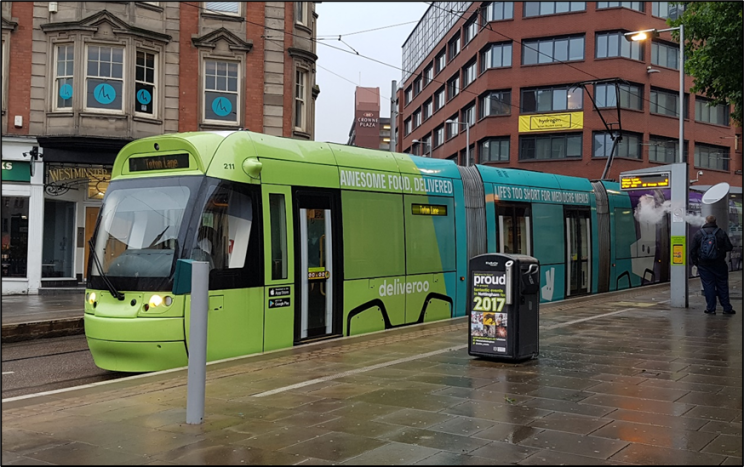
Drivers with Workplace Parking help fund better public transport.
The city saw a reduction in available workplace parking of around 25% over the period in which the levy was introduced[27] and more than 75% of employers pass on the charge in some way[28].
Since implementation the levy has raised over £90 million. The assured income has allowed the Council to borrow and fund over £1billion in transport, including acceleration of delivery of a £570m project to construct two new tram lines. Nottingham continues to thrive economically and expects to achieve carbon neutrality by 2028[29].
The levy has been transformative in enabling those that continue to enjoy city centre parking to assist the funding of a better transport system. It is a missed opportunity that it has not been adopted by more cities throughout the UK, nor a mainstay of city-region policy to create funding to support a programme of modal shift.
|
Recommendation 12. National Governments should establish a selection of cities for which they provide suitable political, legislative and financial support to enable the implementation of WPLs within a defined timescale. |
Extend the Levy Beyond just Workplace Parking
There are a number of ways in which the current Workplace Parking Levy legislation could be improved in terms of application and process. There is scope to:
- Extend the levy beyond just workplace parking
- Streamline the process of introduction
The existing Act makes provision for a “licensing scheme” for imposing charges in respect of the provision of workplace parking places[30]. However, parking levies do not necessarily need to be limited to workplace parking. As the following examples from Australia illustrate, there is scope to widen a levy to include other types of parking.
- The Melbourne Congestion Levy, introduced in 2006, imposes a charge on all long-stay parking spaces in the central business district (CBD) and surrounding inner Melbourne area. It includes private parking spaces provided by workplaces or by retailers for use by shoppers. Parking spaces in car parks open to the public are liable if they are leased or used by commuters[31].
- The Sydney Parking Space Levy, introduced in 1992, applies to off-street commercial (private parking for public use) and private non-residential (workplace) parking spaces[32].
- In Perth, around 50,000 non-residential parking bays, including those used by tenants, occupants, owners and visitors of a site and most public parking in both on and off-street locations, are included in a licence scheme that applies a differential levy based on the types of use[33].
Inclusion of other types of parking could allow a levy scheme the option to apply a charge on spaces provided in public car parks and at retail centres for patrons. Widening the levy scope in this way would mean that most, if not all drivers entering and parking within a city centre or other congested area could make a reasonable contribution for the external costs that their choice to drive into that area causes on other users. It would reflect the additional congestion that their journey causes, and the impact on others’ travel time, the noise, pollution and severance, as well as the impact on risk to vulnerable users.
The Australian schemes have some specific exemptions, and that is likely to be suitable in a UK context.
Streamline the Process of Introduction
The current process requires the Order for the introduction of a workplace parking levy being approved by the Secretary of State for Transport. A number of steps are required to develop the scheme, undertake statutory consultation with business and public and prepare a suitable business case. Indications to date are that a WPL scheme takes around 3 to 4 years to implement. The requirements and obligations placed upon a transport authority for enacting what has the potential to be a standard and accepted arrangement in all our large towns and cities is currently too onerous and burdensome. A rationalised process, requiring fewer established steps and including only key check points, is required.
|
Recommendation 13. The Government should revise the WPL regulations to permit levies on other parking provision beyond just the workplace and streamline the requirements to demonstrate just cause for highway authorities to introduce such levies. |
Revising the Tax Breaks Applied to Travel to Work Mode
As a tax principle, any costs incurred by workers in the process of travelling to or from their normal place of work that are paid for by an employer are considered a benefit-in-kind. There are subject to income tax[34].
Yet, employers may provide, pay for or otherwise reimburse parking charges incurred by employees that park at or near to their workplace, and this is not considered taxable.[35]
In contrast, employers that provide a subsidy or reimbursement for the cost of travelling to the workplace using a scheduled bus, would, in most ordinary cases, be providing a taxable benefit[36].
A number of countries and some US states do see this as a taxable benefit-in-kind. The Canadian Revenue Agency set the benefit based on an assessment of the fair market value of the parking provided.[37]
The overarching challenge to reduce carbon should be present in tax and income policies. The current tax rules encourage and support the choice of car as a mode of transport to travel to work over bus. It would be more consistent with the objectives if bus travel was provided with greater tax breaks, and those applying to car, withdrawn.
|
Recommendation 14. The Government should revise the legislation regarding travel to work tax benefits to ensure, as a minimum, equity between modes and work towards providing additional tax relief for those travelling to the workplace by non-car modes. |
Making the Rateable Value of Parking Appropriate
Other options to effect policy levers from private non-residential parking include examination of enhancing rateable value. Car parks are generally rated per parking space where spaces are marked or by area when not marked. Revenue is collected by the local authority.
Inspection of the value set for parking indicates that the current method of valuing a parking space does not provide a true reflection of its market value. The inventory of parking is also incomplete, inaccurate or otherwise overlooked[38].
|
Recommendation 15. The Government should require The Valuation Office to revise its guidance on the methods used for assessing the rateable value used to assess commercial car parking space, to ensure all spaces are recognised and a full account of the market value of those spaces is used. |
Controlling the Price of Public Car Parking
A key challenge for towns and city councils that may wish to manage down car use through a coherent application of parking charges arises where a significant proportion of the public parking stock is provided by the private sector. Whereas the local authority has control of its own parking tariff, the charges operated by the private sector are often set independently as a commercial decision by the private operator.
As a consequence of changes to working practices since the pandemic, a number of towns and cities in the UK are witnessing a significant reduction in the demand for long-stay public parking. Private car parks operating within a town or city that has an over-supply of parking are often offering low-cost “early bird” tariffs to commuters in order to fill otherwise empty parking spaces. The consequence of this market action undermines attempts by the local authority to establish their own baseline rate for long stay parking at a level that is financially sustainable and also ensures that the costs of using alternative modes of travel into the town or city centre remain attractive. The over-supply of parking creates a race to the bottom for the tariffs offered, which in turn makes driving a cheaper option compared to the train, bus, cycling or walking. This is contrary to the objectives of encouraging mode shift away from car and in particular policies and measures taken to reduce car travel during the morning and evening peaks.

The Control of Off-Street Parking (England and Wales) Order 1978 provides for a county council to designate an urban area within which all off-street parking operated by a private provider must be licensed by the local authority governing the district. Public sector car parks within a licensed area must be operated as if under licence.
The regulations of the county council, and licences issued, may include provision to control the maximum number of spaces offered, type of use (such as short-stay, long-stay, casual or regular), the scale of charges, including minimum or maximums and times of opening and closing.
Licensing an area thus offers a greater level of control and consistency on the parking offer available. Where the market is over-supplied, the introduction of licensing can be expected to stabilise the market rate for parking at a level that is financially sustainable for operators and support carbon-reduction.
Despite the legislation being enabled over 40 years ago, there have been no known applications of licensing of off-street parking in the UK.
|
Recommendation 16. The Government should issue guidance to Highway Authorities regarding the application and suitability of off-street public car parking licencing and promote its adoption in locations with an oversupply of public car parking. |
Encouraging More Efficient Vehicles
A number of authorities apply differential charges to parking based on the vehicle’s engine and emissions rating. An emerging consideration is also vehicle size and mass. Some examples of this include:
- London Borough of Camden. Residents’ parking permits are charged according to the CO2 emissions of the vehicle. Vehicles are assigned to one of a number of charging bands. Those with the greater levels of emissions are subject to a greater charge. Diesel powered vehicles are subject to a further separate uplift. The Council also apply a separate tariff to effect a surcharge for diesel vehicles parking in its car parks or on-street[39].
- Islington. Different tariffs are applied to casual parking at on and off street locations controlled by the borough. Parking machines require the user’s vehicle registration mark. This is linked to the Driver and Vehicle Licensing database to determine engine type. The parking tariff applied is based on engine size and type Islington also operates variable charges for residents’ permits, including being the first borough to charge differential rates for electric vehicles based on the battery size[40].
- Lyon. Different tariffs will apply from 2024 that escalate based on the mass and engine type of the vehicle. The policy also provides concessions for lower income households[41].
- Paris. Parking charges from 2024 are to take account of the vehicle size, its weight and its engine type[42].
One of the key issues in recent years has also been the significant growth in vehicle size and mass. Notwithstanding the additional parking and roadspace that these larger vehicles command, and any poorer efficiencies in respect of fuel use or pollutants generated when moving people around given their intrinsic weight, is the damage to the highway and potential risk that they pose to others. These large vehicles are incongruous to the urban setting in which they are commonly associated[43].

Moving to Lower Emissions Vehicles is a positive step, but the trend to larger vehicles is not
A combination of policies that apply differential ownership and operating costs are suitable measures to encourage car owners to select vehicles that have lower emissions, less mass and size, when they are replaced.
|
Recommendation 17. The Government should promote the use of differential charging for parking based on the characteristics of the vehicle. This could include carbon emissions, vehicle mass, and fuel type. |
Utility Pricing[44]
Current practice is to charge parking predominantly based on duration of stay. But setting the parking tariff based on duration of stay ignores what is actually significant and of value to the user. The parking space enables the user to make that journey by motor vehicle. Without that parking space, irrespective of how long it is used for, the user could not drive and would have to use some less convenient, slower or more uncomfortable option.

Access to this central car park in Chichester provides great convenience for users. But it also has a cost on the local environment
Moreover, charging parking based on duration of stay also ignores the dis-benefits that the user imposes on society when they make the journey by motor vehicle, to and from the parking space. When that parking space is in the centre of a town or city, those costs could be notable. They could include the impact that they have on making congestion worse if they travel at peak times, pollution, noise, the risk to vulnerable users and that their access to and from a car park limits how the roadspace to that car park can be used. This latter point is pertinent in situations where, for example, the road used to access the car park could otherwise be used for a street market or other activity.
Access to a car park in the centre of a town or city provides benefits to the driver, but depending on when that access occurs, it also places different costs on the local community.
In particular instances, the more typical duration of stay charges are warranted. This occurs when a user’s parked vehicle prevents another user from realizing the access and egress benefits otherwise offered by that parking location. While there are spare spaces in the car park, other users can enjoy the full benefits. It is only when the car park is full, that the duration of stay creates societal costs.
Therefore, the charge applied for parking should constitute two components:
- An access charge, representative of the costs incurred on others by those driving to and from the parking space. This charge is determined based on when access and egress is made.
- An occupation charge, applicable when the parking facility is at capacity. This reflects the costs incurred by society by that user preventing another user realizing the access benefits offered by that car park.
The concept behind utility pricing is that the dis-utility generated by those accessing and using parking can be built up from a series of additive charges, applied at and between set times, that are pre-determined and pre-notified. The separate, but additive charges, provides a transparent but rational link between what a user is required to pay for parking and the impact their motor vehicle parking event has on the community. Charges levied for different aspects or impacts can be adjusted to reflect government policy and drive behavioural change.
A move to utility pricing could be achieved without significant divergence from what people are currently paying for parking. The technology to effect variable charges based on time of entry and exit is already established. The move to utility pricing would generate the mechanism to make precise and rational changes to pricing to reflect the value and costs incurred[45]. As environmental costs, or the time of travel, become more important for the local authority, then that element of the composite charge can be accentuated to influence behaviour.
|
Recommendation 18. The Government should provide guidance to local authorities regarding the conditions that make utility pricing suitable, the technologies required and the suggested process for its introduction. |
Moving On with Parking Policy
Unlike new technologies, disruptive markets and societal change in beliefs, attitudes or fashion, the parking space, and much of the legislative and policy framework surrounding its use, is with us already. Reducing the carbon we create is an urgent need. The choices we make when we travel has a bearing on how much carbon we generate.
The overriding thread of the discussion in this document is that changes to the way parking is managed, administered, allocated and charged-for can make notable changes to the daily decisions made by people, regarding not only where they travel, but most importantly, how. These daily, individual decisions, up and down the country, collectively present the potential for a significant change in how much travel is made by private car, and how much our local environments may be revised to encourage and enable other choices. And this is significant in reducing the carbon impacts on our world.
Many of the recommendations we make can be implemented promptly. Some others may need some legislative change.
Parking is here, now and ubiquitous. It has such a fundamental role in all car journeys that these changes will start delivering immediate benefits, both now and for the long term.
Small changes to parking, offers substantial changes to behaviour. And with that, it offers a significant boost to us as we make our most important and urgent journey to date, to decarbonise how we travel.
Find out more at the Transport Planning Society homepage.
References
[1]Planning Policy Guide 13 – Transport (PPG13) 2001 set the framework against which new developments were assessed and parking provision limited based on land use and scale. Maximum parking standards sought to restrain car usage. This reflected a change away from the more common approach up to that point (outside London) of applying minimum parking standards, that required developers to provide at least the amount of parking stipulated.
[2] PPG13 was seeing some results consistent with its policy aims, particularly in urban areas. Research into the Use and Effectiveness of Maximum Parking Standards (Department for Transport, 2008)
[3]the National Planning Policy Framework (NPPF) was introduced in 2012. It considered parking standards to be optional and anyway subject to a number of local criteria
[4] By designing for the car alone we are creating car dependant places (Transport for New Homes, 2022).
[5] NPPF was revised in 2019. It recognised the role of “maximum” parking standards for managing the network and delivering higher density housing.
[6] Town and Country Planning Association (TCPA) ‘Guide 13 Sustainable Transport’
[7] Anable et al. 2022 “Less is more: Changing travel in a post-pandemic society” https://www.creds.ac.uk/wp-content/uploads/CREDS-Less-is-more-web.pdf
[8] “The bin-lorry effect: How new homes and places are ruined by highways’ regulations and how we can fight back” Milner 2021, ‘Create Streets’
[9] Revising the schedule of streets and effectively revising the boundary to which a controlled parking zone applies to exclude exempted properties is being used by, for example, Bristol City Council, Borough of Poole and the London Boroughs of Islington and Southwark.
[10] Described in the “London Borough of Croydon Controlled Parking Zone Study” prepared by WSP & Parking Perspectives (2019) and Birmingham City Council Parking Standards Evidence Base 2019 (s6.17)
[11] Croydon Council’s policy towards the application of parking standards within the Local Plan states that “…in the early years the public transport infrastructure …may not exist …. It may therefore be acceptable for an increased provision of private car parking to be provided in developments in areas with a low Public Transport Accessibility Level if justified by a Transport Assessment.”
[12] “Residential Off-Street Parking Impacts on Car Ownership, Vehicle Miles Traveled, and Related Carbon Emissions” Weinberger R et al., Transport Research Record (January 2009)
[13] United Kingdom Car Club Report 2021 Key Findings
[14] Carplus annual survey of car clubs 2015/16 London
[15] United Kingdom Car Club Report 2021 Key Findings
[16] Birmingham Parking Supplementary Planning Document November 2021. page 29
[17]The City Visitor Charge began in April 2023. Overnight guests in city centre hotels or holiday apartments in Manchester are levied £1 a night, per room, to “improve the visitor experience”
[19] The Road Traffic Regulation Act 1984
[20] Section 72 of the Highways Act 1835
[21] Section 22 of the Road Traffic Act 1988.
[22] Wokingham Borough Council’s “Process for managing parking on verges, footways and footpaths” published on 28th July 2015 sets out its process based on a policy position that the borough will generally not react to pavement and verge parking unless there is a complaint or issue raised.
[23] Policy paper Environmental principles policy statement 31 January 2023
[24] Proposition Climate Change Emergency: Action to be taken by the Government of Jersey (P.27/2019) As adopted by the States on 2nd May 2019. Page 4. “It is recognised that taxation should support economic, social and environmental policy. Developmental work in this area will investigate using environmental taxes and charges to, inter alia, reinforce emissions reduction measures and potentially raise revenue to fund environmentally positive behaviour. For example, review vehicle emissions duty and use revenue to invest in sustainable travel initiatives” (page 4 P.27/2019)
[25] Workplace Parking Levies were set out in the 1998 White Paper “New Deal for Transport: Better for Everyone” and included in the Transport Act (2000). The legislation stipulates the requirement for revenues raised to be hypothecated. The Workplace Parking Levy (England) Regulations (2009) was introduced to provide additional powers for the issuance of penalty charges for non-compliance.
[26] The Transport (Scotland) Act 2019 (Part 7) introduced a discretionary workplace parking licensing (WPL) power available to local authorities. As in England and Wales, it is up to the local authority to decide whether they wish to use that power and to shape proposals to suit local circumstances. Any proposals must be consulted upon and impact assessments conducted. Revenues from the workplace parking levy are to be used to support the policies in the Local Transport Strategy
[27] Evaluating the impact of a workplace parking levy on local traffic congestion: The case of Nottingham UK Dale S, Frost M, Ison S, Quddus M, Warren P., Transport Policy 59 (2017) p153-164.
[28] Information about Nottingham City Council’s WPL Scheme (2021) Hallam & Gooding.
[29] “A decade of inspiring growth in our city. Nottingham’s Workplace Parking Levy. 10 Year Impact Report”. Nottingham City Council. November 2022
[30] Transport Act 2000, Chapter II, Worklpace Parking Levy, Licensing Schemes, section 178 In this Part “licensing scheme” means a scheme for imposing charges in respect of the provision of workplace parking places at premises in the area covered by the scheme to be paid on licences covering the provision of a maximum number of such parking places at the premises
[31] Young, W., Currie, G., & Hamer, P (2014) in S. Ison, & C. Mully, Parking Issues and Policies: Volume 5 (pp. 317-333). Emerald Group Publishing Limited.
[32] Parking Space Levy Act 1992, Sydney, New South Wales. The Legislature of New South Wales. (1992, July 1).
[33] Western Australian Government Gazette 18 November 2014
[34] https://www.gov.uk/tax-relief-for-employees/travel-and-overnight-expenses
[35] Income Tax (Earnings and Pensions) Act 2003 s 237. HMRC Guidance at EIM01030. Where an employer pays for or reimburses an employee for the costs associated with car parking at or near to the employee’s place of work, these amounts are subject to neither tax nor NIC and there are no reporting requirements associated with them. The exemption covers all vehicles, including bicycles and motorcycles.
[36] Income Tax (Earnings and Pensions) Act 2003 s243 exempts this benefit provided certain conditions are met, including a meaningful financial or other contribution by the employer to cause a difference to the particular service(s) that serve the workplace and for which the employee is granted a pass for travel.
[37] Income Tax Act (Canada)1985 [paragraph 6(1)(a)] and Canada Revenue Agency (CRA) guidelines
[38] Parking Perspectives (2022) inspection of the inventory and rateable values applied for business car parking spaces in the city of Chelmsford (unpubl.). Article available at www.parkingperspectives.com.
[39] London Borough of Camden, Parking permit charges.
[40] https://www.islington.gov.uk/parking/parking-permits/ parking-permit-costs-table
[41] M2050 Lyon: First city in France to penalize parking for the heaviest and most polluting vehicles (May 2023) https://m2050.media/en/lyon-first-city-in-france-to-penalize-parking-for-the-heaviest-and-most-polluting-vehicles/
[42] “Paris to charge SUV drivers higher parking fees to tackle ‘auto-besity’, Willsher, The Guardian, https://www.theguardian.com/world/2023/jul/11/paris-charge-suv-drivers-higher-parking-fees-tackle-auto-besity
[43] “The Urban SUVs: Too big for their boots, dangerous to others – and not paying their fair share either” Dales, J. Local Transport Today 873 July 2023.
[44] Potter A, “Utility Pricing for Parking” Parking Review, October 2018 & presentation at Parking World, 9th November 2017, London. Paper available at www.parkingperspectives.com
[44] Charges levied for Utility Pricing may also take account of vehicle characteristics, including engine type, emissions and vehicle size [45] Both established laws provide local authorities the necessary powers to exempt selected footways from the pavement parking prohibition. In London some pavement parking is permitted using marked bays and traffic signs and in Scotland local authorities will be expected to identify streets that are to be exempted in advance of the regulations taking effect. [46] Greater London (General Purposes) Act 1974 [47] Consultation relating to the secondary legislation to implement the Transport (Scotland) Act 2019 closed in July 2023. [48] Both established laws provide local authorities the necessary powers to exempt selected footways from the pavement parking prohibition. In London some pavement parking is permitted using marked bays and traffic signs and in Scotland local authorities will be expected to identify streets that are to be exempted in advance of the regulations taking effect.
The TPS Parking Policy Statement was written by Andrew Potter with support from Alexis Edwards and contributions from Howard Potter. Tom Van Vuren provided editorial review.